


News & Blog Posts
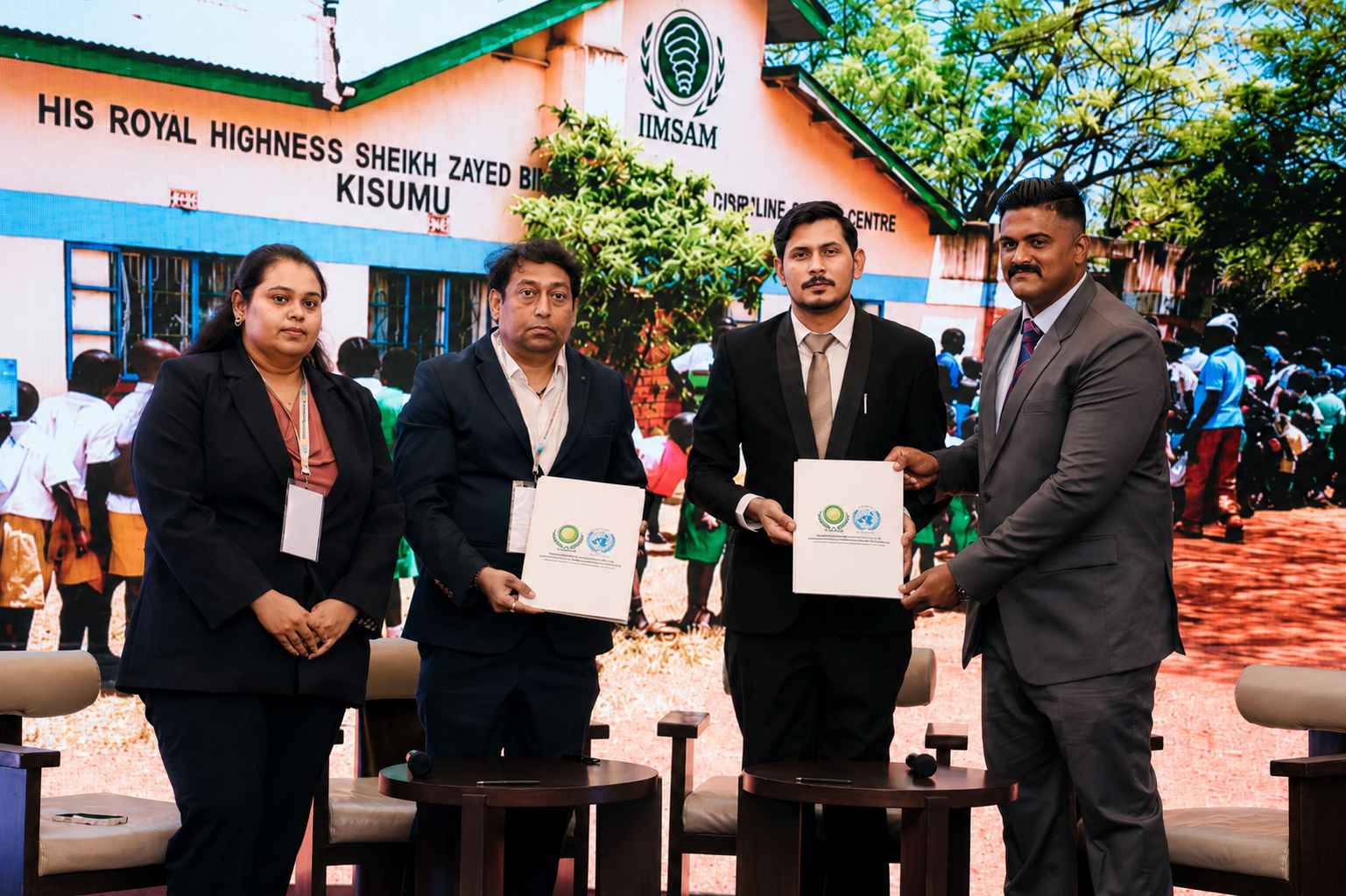
IMSAM and J Joshi Infraprojects Pvt. Ltd. Sign MoU
IMSAM and J Joshi Infraprojects Pvt. Ltd. Sign MoU to Establish a World-Class Cancer & Multispeciality Hospital & Establish an International Spirulina Research & Innovation Centre
New Delhi, India - The fight against global malnutrition is often described through the language of food supply, humanitarian delivery and public health. Yet one of its most consequential foundations is less visible: the scientific and institutional infrastructure that allows nutrition solutions to be tested, refined, produced responsibly and translated into programmes that can reach communities. It is within this broader development context that the Memorandum of Understanding between IIMSAM - the Intergovernmental Institution for the Use of Micro-Algae Spirulina Against Malnutrition - and J Joshi Infra Projects Pvt. Ltd. should be understood.
The agreement establishes a five-year framework for cooperation centred on the proposed International Spirulina Research, Development, Training and Innovation Centre in India. Its significance lies not simply in the creation of physical facilities, but in the institutional capacity such facilities can support: laboratories for applied research, pilot production systems, training spaces for technical personnel, and community-facing facilities that connect scientific work with nutrition outreach.
IIMSAM: Mandate, Institutional Standing and the Case for Spirulina
As a Permanent Observer to the United Nations Economic and Social Council (ECOSOC), IIMSAM operates within the wider multilateral development system and advances a mandate focused on the use of spirulina against malnutrition. Spirulina, a nutrient-dense micro-algae, has long attracted scientific and development interest because of its protein content, micronutrient profile and potential relevance in supplementary nutrition contexts, particularly where vulnerable populations face persistent dietary deficits.
For IIMSAM, the central question has never been whether nutrition science matters, but how scientific knowledge can be converted into accountable, scalable and locally relevant programmes. That transition depends on more than advocacy. It requires research capacity, quality control, training, technical documentation, partnerships with implementing institutions and the ability to link global development priorities with practical delivery systems on the ground.
Why Infrastructure Has Become Essential to Nutrition Security
Nutrition security is shaped by food availability and access, but also by the institutions that generate evidence, train specialists and support resilient programme design. Laboratories and pilot facilities allow researchers to test production methods, examine quality parameters, document results and improve implementation before solutions are introduced into wider community settings. In this sense, research infrastructure is not separate from humanitarian impact; it is one of the conditions that makes responsible impact possible.
This places the partnership in direct conversation with the Sustainable Development Goals. SDG 2 calls for ending hunger and all forms of malnutrition. SDG 3 links nutrition to health and well-being. SDG 9 recognizes industry, innovation and infrastructure as foundations of sustainable development. SDG 17 frames partnerships as a practical necessity for achieving goals that no single institution can deliver alone. The proposed centre sits at the intersection of these priorities by linking nutrition science, infrastructure development and international cooperation.
The Strategic Partnership with J Joshi Infra Projects
Under the MoU, IIMSAM and J Joshi Infra Projects are expected to collaborate on the planning and development of infrastructure for spirulina research, training, innovation and community nutrition outreach. J Joshi Infra Projects, which describes its work as spanning residential, commercial, industrial, hospitality, logistics and smart-city-linked developments in Gujarat, brings experience in infrastructure planning, project coordination and real-estate development. IIMSAM contributes its institutional mandate, international development perspective and technical focus on spirulina as a nutrition resource.
The proposed International Spirulina Research, Development, Training and Innovation Centre is intended to provide a platform where scientific inquiry and applied implementation can reinforce one another. Planned components include research laboratories, pilot production facilities, training and capacity-building spaces, and facilities connected to community nutrition outreach. Read together, these elements suggest a broader institutional model: one that treats infrastructure as an enabler of research, education, technology transfer and public benefit rather than as a construction exercise alone.
The five-year collaboration framework is important because nutrition research and institutional development require continuity. Facilities must be planned, governed, staffed, equipped and evaluated over time. A durable framework can help both organizations move beyond the symbolism of a signing ceremony toward a process in which responsibilities, milestones and implementation mechanisms are progressively clarified.
Building Institutional Capacity Through Research Infrastructure
The most valuable outcome of the partnership will depend on whether it strengthens institutional capacity. For nutrition systems, capacity is not only a question of funding or facilities; it includes trained researchers, credible protocols, interdisciplinary collaboration, reliable data, community feedback and the ability to adapt programmes as evidence develops. Infrastructure can support each of these functions when it is designed around public purpose and governed with transparency.
For India, the proposed centre could also contribute to a broader ecosystem of scientific exchange and technical training. Spirulina-based nutrition work requires expertise across biology, food systems, public health, production management, quality assurance and community engagement. Bringing these disciplines into a shared institutional setting may help convert fragmented knowledge into practical capacity that can support evidence-based policymaking and future partnerships with academic, public-sector and civil society actors.
Diplomacy, Development and Cross-Sector Collaboration
The MoU also reflects a wider change in development diplomacy. International cooperation today is not confined to negotiations among governments. It increasingly includes partnerships among intergovernmental organizations, infrastructure developers, researchers, universities, civil society groups and private-sector institutions. These relationships are not substitutes for public responsibility, but they can expand the technical and institutional base available to address complex development challenges.
In the case of malnutrition, that complexity is especially clear. Scientific discovery must be connected to safe production, programme monitoring, local acceptance, public health priorities and long-term sustainability. A partnership between an intergovernmental nutrition institution and an infrastructure developer therefore carries policy relevance only if it produces stronger systems: better places to conduct research, better channels for training, and better mechanisms for translating knowledge into community-level benefit.
Looking Ahead: From Agreement to Impact
The next phase will determine whether the partnership's institutional promise becomes operational. Early indicators will include the development of an implementation roadmap, the establishment of governance mechanisms, the identification of technical partners, and the gradual activation of research, training and outreach components. Over time, the centre could support scientific exchange, regional knowledge hubs, technology transfer and training programmes for practitioners working at the intersection of nutrition and sustainable development.
Running alongside these institutional efforts is IIMSAM's broader community-facing mission, including initiatives that seek to improve awareness of spirulina's potential role in nutrition support. The proposed centre can complement that mission by creating the research and training backbone needed for programmes to be designed with stronger evidence, clearer protocols and more durable institutional support.
Conclusion
It is best to view the IIMSAM-J Joshi Infra Projects partnership as a framework for institution-building rather than as an endpoint in itself. Infrastructure alone does not solve malnutrition. Its value lies in what it makes possible: scientific research, responsible innovation, capacity building, technology transfer, training and practical solutions that can be tested, improved and delivered with care. As with all development partnerships, the true measure of success will not be the signing of an agreement, but the knowledge generated, the institutions strengthened and the communities ultimately served.
References
IIMSAM. (n.d.). Support IIMSAM Support Life. https://iimsam.org/
J Joshi Infra Projects Pvt. Ltd. (n.d.). About us. https://jjoshiinfra.com/about-us/
United Nations. (2015). Transforming our world: The 2030 Agenda for Sustainable Development (A/RES/70/1). United Nations General Assembly.
United Nations Department of Economic and Social Affairs. (n.d.). Sustainable Development Goals 2, 3, 9 and 17. https://sdgs.un.org/goals
World Health Organization. (n.d.). Malnutrition. https://www.who.int/news-room/fact-sheets/detail/malnutrition
Search Here

Blog Categories