


News & Blog Posts
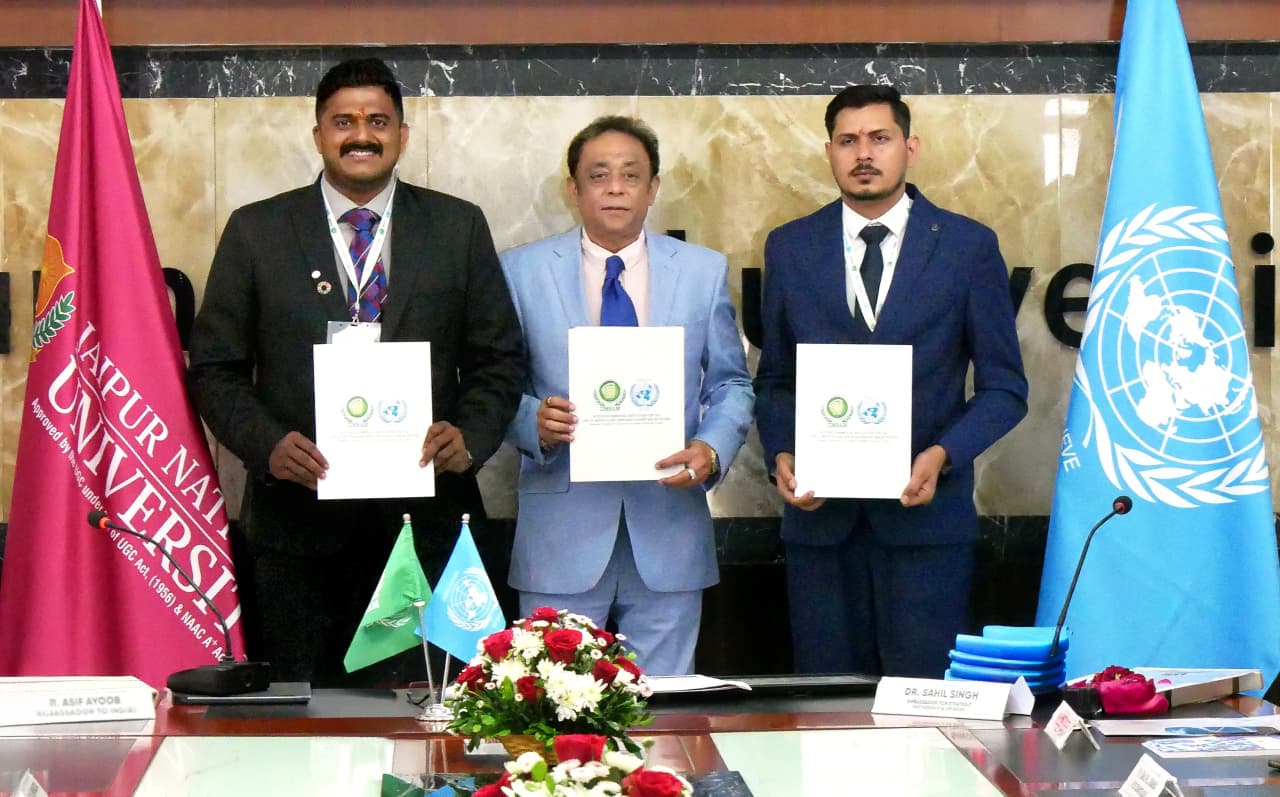
IIMSAM and Jaipur National University Partner to Combat Malnutrition with Spirulina in 2025
Spirulina Superfood Meets Global Diplomacy: How IIMSAM and Jaipur National University Are Building a New Front in the Fight Against Malnutrition
IIMSAM, the UN ECOSOC observer institution dedicated to Spirulina against malnutrition, has signed a landmark MoU with Jaipur National University to advance global hunger solutions, nutrition security, and SDG 2.
The Crisis That Refuses to Wait
More than 733 million people go to bed hungry every night. Nearly two billion more suffer from micronutrient deficiency — a condition so silent and so widespread that researchers call it "hidden hunger." Children born into it face stunted growth, impaired cognitive development, and diminished life chances before they ever reach a classroom. Mothers living with it bear the compounded burden of their own poor health alongside the responsibility of nourishing the next generation.
Global hunger solutions are not in short supply. What has been missing — for too long — is the institutional architecture to deliver them: partnerships built on science, anchored in policy, and capable of moving from research to action at the speed the crisis demands.
In 2025, one such partnership was born.
IIMSAM: The Institution That Turned a Microalgae Into a Mandate
IIMSAM — the Intergovernmental Institution for the Use of Micro-Algae Spirulina Against Malnutrition — is not a conventional organisation. Registered under United Nations Treaty Series No. 37542-37543 and designated as a UN ECOSOC observer, it occupies a rare position at the intersection of science, international law, and humanitarian action.
Its mandate is precise: to promote and disseminate Spirulina, a blue-green microalgae that the UN Food and Agriculture Organisation has called one of the most promising foods for the future, as a primary instrument in the fight against malnutrition — particularly in developing countries, conflict zones, and climate-vulnerable communities.
Spirulina superfood is no marketing label. Gram for gram, it contains approximately 60–70% protein by dry weight, more iron than spinach, a full complement of essential amino acids, and a concentration of vitamins, antioxidants, and bioactive compounds that make it uniquely suited to addressing micronutrient deficiency in children and at-risk adults — affordably, rapidly, and at scale. The World Health Organization has noted that Spirulina is rich in iron and protein and can be administered to children without any risk. The FAO has called for governments and intergovernmental bodies to re-evaluate its potential as a tool for food security and emergency nutrition response.
IIMSAM has made that re-evaluation its life's work. And through its partnership with Jaipur National University, it is now building the institutional infrastructure to act on it.
Jaipur National University: Academic Depth for a Global Mission
When an institution operating at the UN ECOSOC level chooses an academic partner, it chooses carefully. Jaipur National University, with its established faculties in health sciences, social development, and applied research, represents precisely the kind of university that can translate international mandates into locally-grounded, evidence-based action.
This is not a ceremonial alliance between a prestigious name and a global brand. It is a functional partnership — one where each institution fills a gap the other cannot fill alone. IIMSAM brings the mandate, the multilateral relationships, and the scientific framework around Spirulina for child malnutrition and broader humanitarian nutrition intervention. JNU brings the research infrastructure, the training capacity, and the academic credibility to develop, test, and scale those interventions.
The result: a university collaboration for global health that operates simultaneously at the level of international policy and community health delivery.
The MoU: Four Pillars of a Long-Term Commitment
The Memorandum of Understanding signed between IIMSAM and JNU is built on four interlocking areas of cooperation — each necessary, none sufficient on its own.
Academic Research is the foundation. Joint, peer-reviewed studies on nutrition security, Spirulina food security in developing countries, and sustainable food systems will generate the evidence base that can guide both programming and policy. This research is designed not to sit in journals but to be applied — to change what gets served in school feeding programmes, what gets distributed in refugee camps, what gets prescribed in community health clinics.
Healthcare Initiatives translate that evidence into delivery. Through coordinated programmes, the partnership will work to expand access to evidence-based nutritional healthcare for vulnerable communities — particularly children under five, pregnant and lactating women, and populations facing climate-driven food insecurity. The focus is always on global hunger solutions that are not just scientifically sound but operationally realistic in low-resource settings.
Capacity Building ensures that the impact outlasts any single programme. A partnership that delivers results today but leaves no trained professionals behind is a temporary fix. IIMSAM and JNU are committed to building skilled professionals in capacity building for nutrition practitioners equipped with both the scientific knowledge and the practical tools to carry this work forward for decades.
Humanitarian Action ties everything to the global framework. All initiatives under this MoU will align with United Nations humanitarian principles and with the intergovernmental organisation nutrition protocols that govern IIMSAM's mandate — ensuring that work done on the ground is recognised, reported, and capable of being replicated across geographies.
A New UN Goodwill Ambassador for an Old Crisis
Among the most significant outcomes of this partnership is the appointment of Dr Sandeep Bakshi, the Hon'ble Chancellor of Jaipur National University, as a UN Goodwill Ambassador by IIMSAM.
The title carries weight because the record behind it does. Dr Bakshi has spent years advancing education access, leading healthcare outreach initiatives, and championing social development programmes deeply aligned with IIMSAM's mission and the United Nations' broader agenda. His appointment as UN Goodwill Ambassador is a recognition that the fight against malnutrition needs advocates who lead not with rhetoric but with demonstrated, documented institutional impact.
In this role, Dr Bakshi will serve as a global voice for nutrition security — bringing academic authority and institutional reach into spaces where those qualities are most needed: donor briefings, policy forums, community mobilisation efforts, and international advocacy platforms.
Rooted in the UN Sustainable Development Goals
Every initiative under the IIMSAM–JNU partnership is deliberately anchored to four of the United Nations' Sustainable Development Goals — the globally agreed benchmarks against which human progress is measured and reported.
SDG 2 — Zero Hunger is the moral and operational centre of this collaboration. It is the goal that defines IIMSAM's mandate and the standard against which this partnership will ultimately be judged. Every research project, every health programme, every training module will be evaluated against a single question: does this bring the world closer to SDG 2 Zero Hunger?
SDG 3 — Good Health and Well-Being reflects the understanding that nutrition and health are inseparable. Addressing malnutrition is not only a food security issue — it is a public health imperative. The healthcare initiatives under this MoU are designed to deliver on both dimensions simultaneously.
SDG 4 — Quality Education speaks to the capacity building pillar. Investing in the education of nutrition and global health professionals is one of the highest-leverage interventions available. A single well-trained practitioner can serve communities for thirty years. This partnership is making that investment.
SDG 17 — Partnerships for the Goals is, in many ways, the meta-goal this MoU itself embodies. The SDGs cannot be achieved by any single institution, government, or sector. They require exactly the kind of MoU university partnership that IIMSAM and JNU have committed to building — multi-stakeholder, cross-sector, and built for the long term.
The Delegation Behind the Agreement
The signing ceremony was attended by two senior IIMSAM representatives: Dr Sahil Singh, IIMSAM's Ambassador for Strategic Partnerships and UN SDGs, and Asif Ayoob, IIMSAM's Ambassador to India. Their presence was a statement of institutional commitment — this agreement is backed by people accountable for its delivery, not filed and forgotten.
The Jaipur National University IIMSAM MoU now stands as a live, operational document with named parties, defined pillars, and a shared timeline for action.
What the Research Says: The Science Behind the Strategy
The urgency of this partnership is underscored by the data. In 2024, the average cost of a healthy diet globally reached over USD 4 per person per day — a figure out of reach for billions. More than three billion people cannot afford nutritionally adequate food. Spirulina for child malnutrition has shown measurable clinical results: in prospective studies, children receiving Spirulina supplementation showed significant improvements in weight-for-age and weight-for-height scores within 30 days.
The Spirulina market is also growing rapidly — projected to expand significantly between 2024 and 2034 — reflecting both rising awareness of its nutritional value and increasing government interest in Spirulina as a tool for addressing food security in developing countries. Governments in India, Angola, and Ghana are already actively supporting local Spirulina production. IIMSAM's partnership with JNU positions the institution to contribute meaningfully to this global momentum — with science, training, and field-tested programming that can inform national and international nutrition policy.
Looking Forward: The Work Begins Now
An MoU is a beginning, not an achievement. The real work — designing humanitarian nutrition interventions, co-developing curricula for capacity building in nutrition, publishing joint research on Spirulina food security in developing countries, and delivering community health programmes to the populations who need them most — starts now.
This partnership is built for the long horizon. The problems it addresses took generations to develop and will take sustained, coordinated, principled effort to resolve. What makes the IIMSAM–JNU collaboration significant is not the signing ceremony. It is the architecture behind it: research connected to practice, academia connected to humanitarianism, and a local institution connected to a UN-recognised body fighting hunger at the global level.
A Shared Conviction, A Common Direction
What ultimately unites IIMSAM and Jaipur National University is not just complementary expertise or aligned programming. It is a shared conviction that malnutrition is not an inevitable feature of the human condition. It is a solvable problem. It has known mechanisms, tested solutions, and dedicated institutions. What it requires is exactly what this partnership provides: commitment, coordination, and the courage to act at scale.
Together, guided by the science of Spirulina superfood nutrition, anchored in the frameworks of SDG 2 Zero Hunger and nutrition security, and empowered by the reach of a UN ECOSOC observer institution working alongside a leading academic university, IIMSAM and Jaipur National University are building toward a world where no child's potential is limited by hunger, and no community is left behind simply because the right knowledge and the right partnerships never reached it.
That world is possible. This MoU is one more step toward it.
Published by IIMSAM — Intergovernmental Institution for the Use of Micro-Algae Spirulina Against Malnutrition UN ECOSOC Observer
Search Here

Blog Categories